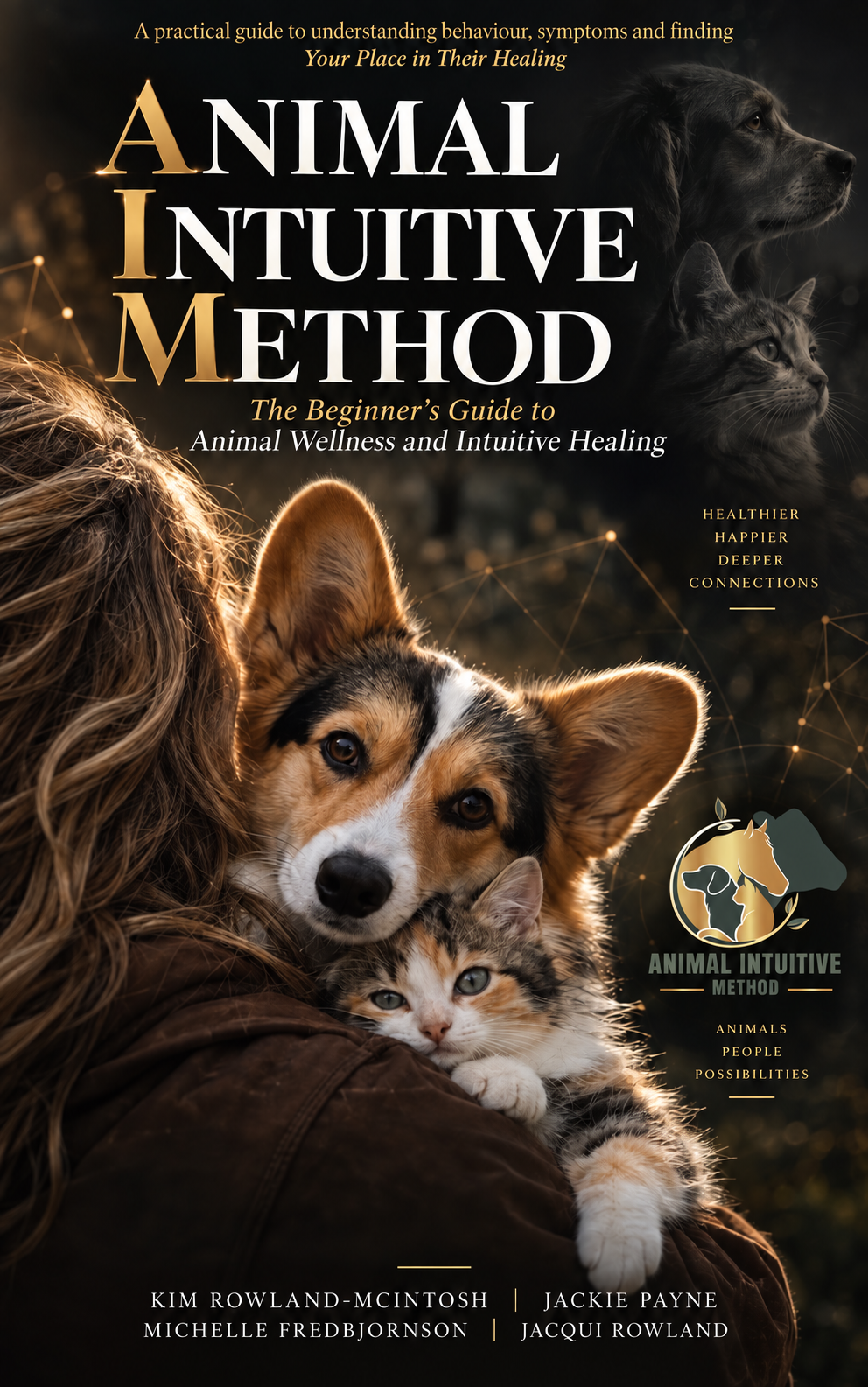
The Animal Intuitive Method
— A new book by Kim Rowland-McIntosh, Jackie Payne, Michelle Fredbjornson, Jacqui Rowland —

Your animal isn't broken.
You've just never been
taught to listen.

Discover what your dog, horse, or cat has been trying to tell you — and why understanding that changes everything.

Yes! Rush me a copy — $20
Ebook only · Instant download

The Problem Nobody Names

You've done everything right. You've seen the vet. Run the tests. Changed the food. Hired the trainer. Tried the supplements, the spray, the collar, the second opinion, the Facebook group with 40,000 strangers who all contradict each other.

And the behaviour is still there. The symptom is still there. The 2am spiral is still there.

Most people at this point conclude they haven't found the right fix yet. So they keep looking.

Here's what nobody says out loud: the fixing is the problem.

You've been handed one question your whole life. "How do I make this stop?" Every vet, every trainer, every product, every midnight Google tab is built around that question. And it's the wrong question. Not because the professionals are wrong. Because the question itself points in the wrong direction.

Your animal is not malfunctioning. The licking, the pawing, the reactivity, the cribbing, the not-eating. Every one of those is a sentence. It has meaning. It came from somewhere. It's pointing at something. And nobody, not the vet, not the trainer, not the supplement company, was ever going to find it by trying to make it stop.

The body was already talking. You were just never taught how to listen.

If you've sat with an animal and thought, there is more going on here than anyone is willing to name, you were right. That thought is not sentiment. It's accuracy.

Symptoms are not problems. They are communication.

The Shocking Truth About Why You're Still Stuck

Here's what most people believe: if they keep trying things, eventually something will work. That's reasonable. It comes from love. It also comes from a framework that treats symptoms as problems to eliminate, which means the only logical response is to keep eliminating until one sticks.

But symptoms are not problems. They are communication. The dog who licks her paws until they're raw isn't broken. She's been saying the same sentence for eight months, and everyone in the room has been trying to shut her up instead of listening.

When you treat communication as malfunction, you can chase it forever and never arrive. Because the body doesn't give up. It just keeps sending the message in louder and louder ways, until someone finally pauses long enough to ask a different question.

The question is not "how do I fix this?" It's "what is this body trying to tell me?"

That one shift changes everything downstream. Not because it's poetic. Because it's accurate. When you understand what the body is actually communicating, every decision you make next, every vet appointment, every training session, every feed change, lands more precisely. You stop paying for answers to the wrong question.

Why Traditional Approaches Keep You Trapped

The fix-it reflex runs on four tracks, and most owners are running at least two of them at any given time. The next supplement. The next trainer. The next opinion. The midnight Google spiral. Each one produces a small pulse of hope that fades inside a week.

None of these tracks are foolish. They come from being a responsible owner inside a system that only ever sold you one question. The whole wellness industry, human and animal, is built on the assumption that the answer is a product that makes the bad thing stop. Nobody put the other question in your hands. So of course you couldn't reach for it.

The structural reason you stay stuck is simple. Bloodwork can come back clean while an animal is quietly falling apart. X-rays can be normal while a horse is carrying pain from an event two years ago. A standard diagnostic measures the physical layer. But emotions, stored experiences, nervous system dysregulation, the ripple of a household going through a hard season, none of that shows up on a panel. All of it can drive behaviour. All of it can drive symptoms. And when the only tools in the room measure one layer, the other layers keep speaking, and nobody translates them.

So the symptom returns. And returns. And you're told, gently, that everything looks fine.

See, I Was Just Like You

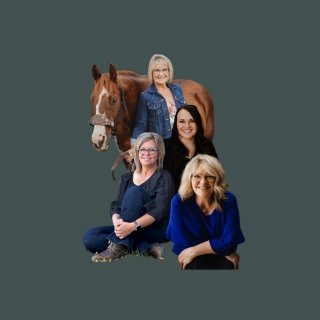
Four of us built this work. Our paths were different. The animals were different. The losses were different. But the lesson was the same every time.

Kim's dog Gracie was five years old when her heart failed. For months before the diagnosis, there had been small things, subtle changes, odd behaviours that never quite seemed serious enough. Gracie was stoic. She kept going, kept loving, kept hiding how sick she really was. After the diagnosis, after the two-to-five month prognosis, Kim stopped asking only how to help Gracie and started asking what else was influencing her. She brought together everything she knew from years of working with people, the nervous system work, the body-based practices, the holistic frameworks, and applied them to her dog in a way she never had before. Gracie lived another fourteen months. The veterinary team was surprised. Kim was changed.

Jackie came to this through her cattle. As a purebred cattle producer, she knew her animals. When she started learning holistic modalities after her husband got sick and recovered in ways conventional medicine hadn't fully explained, she turned to the herd as her teachers. Then came Ally, a six-year-old Limousin cow who cooperated but never quite settled. Jackie started asking what Ally needed instead of what was wrong with her. Ally walked into Farmfair International that fall and won Supreme Champion. The championship was visible. What the family saw was something larger. They had stopped managing an animal and started listening to one.

Michelle lost her daughter Jacey. Three months before Jacey died, she quietly pointed at a horse and told her mother, "Mom, you need this horse." After Michelle was broken open by grief, she found him. His name was Little Hawk. The first time they met, he walked straight to her and rested his head against her chest. He didn't ask her to be okay. He simply met her where she was. Over the years, he became one of her greatest teachers. He helped her understand that healing is not something you force. It unfolds when something is finally safe enough to soften.

Jacqui had trusted horses since she was a child. She had spent decades helping people heal, developing tools to support the body, release emotional stress, and help the nervous system return to balance. Then someone asked her to work with their horse. Everything she had ever known came together in that session. Her own horse, Fred, became another teacher. When she became grounded, he softened. When she trusted, he trusted. When she listened instead of trying to control, everything changed.

Four founders. Four animals. One realization, arrived at separately, and then together. The body was already talking.
The Behaviour Revolution

Behaviour is communication. Not a problem. Not a failure. Not a character flaw in your animal. A sentence.

Every symptom, every change, every behaviour that showed up out of nowhere and won't leave, is the body's way of pointing at something that hasn't been heard yet. Once you understand that at a level below the intellect, not just as a concept but as a reflex, the way you stand next to an animal changes completely. You stop trying to eliminate the message. You start trying to read it.

That is the shift the AIM Communication Framework was built to make practical.

The AIM Communication Framework

The Animal Intuitive Method is a whole-animal approach that brings together anatomy, physiology, nervous system regulation, intuition, and muscle testing into one practical, repeatable framework. It does not replace veterinary medicine. It works alongside it, by helping you understand what the body is communicating across physical, emotional, nervous system, and environmental layers, so the underlying factors driving behaviour and health challenges finally come into view.

01
Tune In
Before you look at the animal, you look at yourself. Your nervous system is the instrument you are reading with. If it is running hot, everything you pick up will be contaminated by your own state. Tuning in means arriving, regulating, setting down the mental checklist long enough to be present with what is actually in front of you. Two minutes of this changes the quality of everything that follows.
02
Understand What the Body Is Communicating
Once you are genuinely present, you begin asking a different question. Not what is wrong. What is the body trying to communicate, and where is that communication coming from? The AIM framework uses eight pillars as windows into the animal's experience: Physical, Nervous System, Emotional, Environmental, Nutritional, Energetic, Relational, and Previous Experience. You move through them with intuition and muscle testing, letting the body lead rather than confirming what you already suspect.
03
Support Balance
When the body has shown you where its priority is, you offer support. Not force. Not intervention aimed at eliminating a symptom. Practical tools, including the Governing Meridian Trace and the Three Brains decision-making process, that help the body's systems work together the way they were designed to. One change. Then you observe. Then you listen again.
Yes! Rush me a copy — $20
Instant download

What Others Are Saying

"I came to this because my mare had been 'difficult' for two years. Three weeks in I realized the difficulty was mine. She's been trying to tell me something I didn't know how to hear."

— Reader, horse owner

"I spent probably eight hundred dollars on food my dog wouldn't eat. Forty minutes with this framework and I had the answer. She wanted raw. She'd been saying it the whole time."

— Reader, dog owner

"I'm a nurse. I ask good questions and I want evidence. I was skeptical at every step. And now I use AIM every single day alongside my veterinary team."

— Reader, nurse and dog-care professional

Proven Results

Mackenzie came to AIM the way a nurse approaches anything unfamiliar: carefully, with a lot of questions and no intention of handing over her belief without a reason. She had built a dog-care business, grooming, boarding, some training, and it wasn't yet covering what nursing did. She booked a session before committing to anything, because she wanted to experience the work before she evaluated it.

Something clicked. Not dramatically. A piece she'd been carrying for years found where it belonged. She joined the Practitioner Program, worked through it with the same methodical attention she brought to clinical work, and started offering AIM sessions alongside what she was already doing. Between January and June, she replaced her nursing income. Same town. Same dogs coming through the same door. The difference was a new way of understanding the animals in front of her. Her clients felt it. Their dogs felt it. The business reflected it.

What You'll Discover Inside

01
Why your animal's "problem behaviour" is actually a sentence
The book opens by reframing symptoms as communication. Once that shift lands, the way you respond to everything else changes.
02
The Fix-It Reflex and what it's quietly costing you
A close examination of the four tracks most owners run simultaneously, and why chasing better answers to the wrong question keeps the cycle running.
03
The one question that changes every decision downstream
Not a technique. A single question that reorients the whole relationship. "What is this body trying to communicate?" and what becomes available once you can actually answer it.
04
The eight pillars and how to use them
Physical, Nervous System, Emotional, Environmental, Nutritional, Energetic, Relational, and Previous Experience. Eight windows into what your animal is carrying, and a practical way to find out which one matters most right now.
05
Muscle testing, explained for people who don't believe in it yet
How to begin with the sway test and the finger ring test, what to do when your analytical mind tells you you're making it up, and why the skeptics often turn out to be the most precise practitioners.
06
The Governing Meridian Trace
A simple, hands-near technique for supporting nervous system regulation, including how to use it with an animal who cannot be touched, and why distance doesn't disqualify the work.
07
The Three Brains decision-making process
Heart, head, gut. A way of making decisions that honours all three rather than running everything through the analytical mind alone, and what changes when all three are in agreement.
08
Four case patterns walked through end to end
A practitioner who was the case. An owner facing a surgery she didn't believe in. A paw-licking Lab whose household routine was the answer. A horse whose rider was the problem. Same three steps, four completely different answers.
09
The 30-day practice plan
Week by week, session by session. Not a rigid curriculum. A structure for building the habit before you feel ready, because readiness is a byproduct of practice, not a prerequisite for it.
10
The shift from doing AIM to living it
What changes when the pause becomes a reflex, what quietly falls away, and why the people who go furthest with this work are almost never the ones who arrived thinking they had a gift.

Is This Right For You?

This is NOT for those who —
  • Are looking for the right supplement on page 140.
  • Cannot spare two minutes to regulate before they begin.
  • Need everyone in their life to approve before they proceed.
  • Want to argue their way through every chapter rather than test it against their own animal.
This is for —
  • The person who has sat with an animal and thought, there is more going on here than anyone is willing to name.
  • Someone who has tried the mainstream route, responsibly and thoroughly, and something in you keeps suspecting the framework is too small for what your animal is actually presenting.
  • Anyone willing to slow down, stay curious longer than feels comfortable, and be prepared to have the body lead rather than your assumptions.
  • People with no prior knowledge of energy work, muscle testing, or holistic medicine. You only need to be willing to practice.
Yes! Rush me a copy — $20
Instant download

Frequently Asked Questions

Is this just another animal communication book?
No. AIM is not about receiving intuitive messages from animals in the way that phrase is usually understood. It is a practical, repeatable framework that uses intuition and muscle testing as assessment tools alongside knowledge of anatomy, physiology, and nervous system function. The goal is not a mystical connection. It is accurate, useful information you can act on.
Do I need experience with energy work or holistic medicine?
No. Many of the people who have gone furthest with this work arrived completely new to it. What matters is willingness to practice. The tools in this book, including the sway test, the finger ring test, and the Governing Meridian Trace, are taught from the ground up. Fluency comes from doing, not from prior knowledge.
How quickly will I see results?
That depends on what you mean by results. Some readers notice a shift in how they relate to their animal within the first week of practicing the Tune In step alone. Others take longer to feel confident with muscle testing. The framework is not a quick fix, because it is not built around fixing. It is built around understanding, and understanding deepens over time.
Does this replace my veterinarian?
Absolutely not, and the book does not suggest otherwise. AIM was built to work alongside veterinary medicine, not instead of it. When something is wrong, you call the vet. When the diagnostics come back and something still isn't right, AIM gives you another set of questions to ask. The two approaches are designed to complement each other.
What if I try the exercises and feel like I'm making it up?
You will feel like you're making it up. Almost everyone does, at the start. The book addresses this directly in the chapter on common mistakes and gives you a specific way to rebuild confidence when the analytical mind takes over. The answer is not willpower. It is returning to basics and doing the reps until the language becomes familiar.
Can I use this if I'm not near my animal, or if my animal won't let me touch them?
Yes. One of the less obvious aspects of AIM is that physical contact is not required for the work. The book explains why, and covers how to support fearful or untouchable animals using the same framework. Several of the case examples in the book involve animals who could not be approached directly.
Kim Rowland-McIntosh, Jackie Payne, Michelle Fredbjornson, Jacqui Rowland

Kim Rowland-McIntosh, Jackie Payne, Michelle Fredbjornson, Jacqui Rowland.

Kim Rowland-McIntosh, Jackie Payne, Michelle Fredbjornson, and Jacqui Rowland came to this work from four different directions. Kim through the loss of a dog who lived longer than she was supposed to. Jackie through a championship cattle operation and a cow who taught the whole family to ask a better question. Michelle through grief so complete it left her with nothing but the patience to listen. Jacqui through decades of helping people heal, and a horse who kept reflecting her own state back to her before she was willing to see it.

None of them planned this. Each followed something their animals were showing them, until the paths crossed and the method became clear. What they had developed, separately and then together, was a way of reading what animals are communicating beneath the visible symptom, and a practical framework for doing something useful with that information.

The Animal Intuitive Method has since supported thousands of animals and the people who love them. The four founders continue to teach it, refine it, and offer it to owners, practitioners, and professionals who sense there is more to healing than what the current conversation allows. Their shared conviction has not changed since the beginning. Every animal has a story. Every behaviour has a purpose. Every body holds an extraordinary capacity to return to balance when it is finally given the right kind of attention.

Your animal has been waiting for this conversation.

They are not broken.
They have been talking.
This is how you listen.

Right now, somewhere in your house or your barn or your paddock, there is an animal doing the thing that brought you to this page. They have been saying the same sentence for weeks or months or years, in the only language they have, and hoping that one day someone in the room would pause long enough to hear it. That person is you.

Yes! Rush me a copy — $20
30-day refund · Ebook only · Instant download